Payment options
Each service is either Free or Paid. On a Paid service, you choose which payment methods clients can use — and you can turn on more than one at once:
- Card — clients pay by card online at booking time. Needs Mollie connected.
- VippsComing soon — clients pay with VippsComing soon at booking time. Needs your own VippsComing soon agreement connected directly (see below). Mollie lists VippsComing soon too, but its support for it is still in limited release and not switched on for Stund yet — so for now, connecting VippsComing soon directly is how you take it.
- Invoice (Klarna) — clients choose invoice through Klarna at checkout. Klarna is also a Mollie payment method, so it needs the same Mollie connection.
- Pay on arrival — clients pay you directly in person; no online payment happens.
Turn on any combination that fits your business — card plus pay on arrival, say, lets clients choose between paying online now or paying you when they show up. If Pay on arrival is the only method turned on, the service works like the old "offline" payment option: the booking confirms (or waits for approval) with no online payment, and you collect payment in person. If any online method is turned on, clients booking that service are taken to a payment page where they pick among the enabled options.
Set this up in the service editor. Any method that isn't available yet shows as disabled there, with a hint pointing to Settings → Payments.
Two ways to take payments
Go to Settings → Payments and pick the one that suits you. You can change your mind later, and connecting both is fine.
Mollie — one connection that covers card and invoice. Setting it up means verifying your business with Mollie and giving them a bank account for payouts. Choose this if you want to take card payments. (Mollie will eventually cover VippsComing soon as well; until it does, VippsComing soon shows as "coming soon" on a Mollie-only account.)
VippsComing soon MobilePay, directly — your own VippsComing soon agreement, used only for VippsComing soon. You sign up with VippsComing soon using BankID and your organization number, then paste four values from your VippsComing soon portal into Stund. Money goes straight into your own VippsComing soon account. Choose this if your clients pay with VippsComing soon and you would rather not set up anything else — you do not need a Mollie account at all.
Connecting both is fine and is the usual answer if you want card and VippsComing soon: card and invoice go through Mollie, and VippsComing soon goes through your own VippsComing soon agreement — straight into your VippsComing soon account, with no middleman.
If neither is connected and you offer paid online sessions, a payment setup prompt appears at the top of the overview dashboard for organization owners with a direct link to set up payments. If onboarding is in progress, the prompt reflects that verification is pending and lets you check status. You can dismiss it for the current browser session (Not now or the close button) or permanently (Don't show again); otherwise it returns on your next visit until you connect a provider.
Connecting Mollie
- Go to Settings → Payments
- Click Connect Mollie
- You'll be guided through Mollie's own verification (business info, bank details)
- Once verified, turn on card and/or Klarna on any paid service
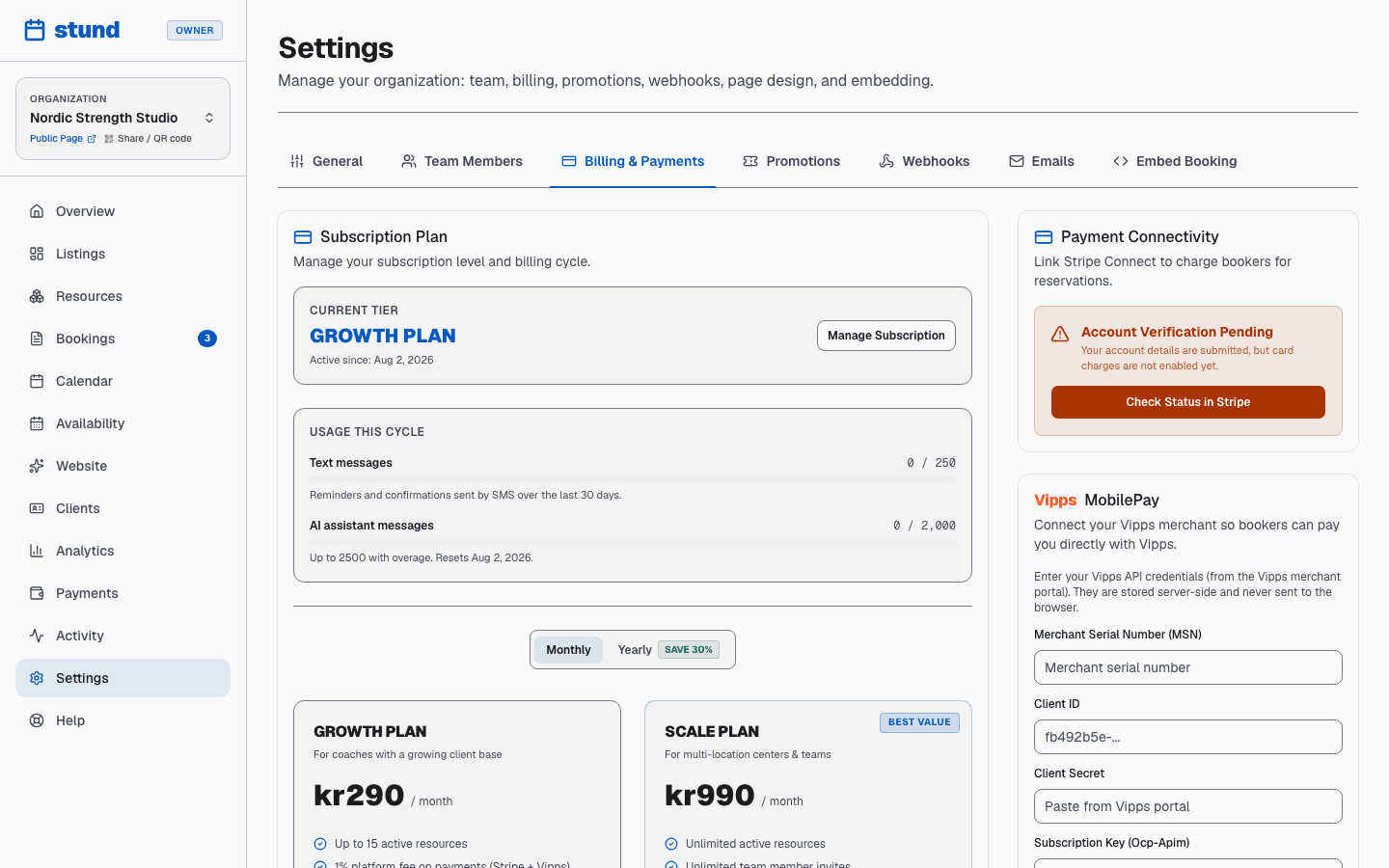
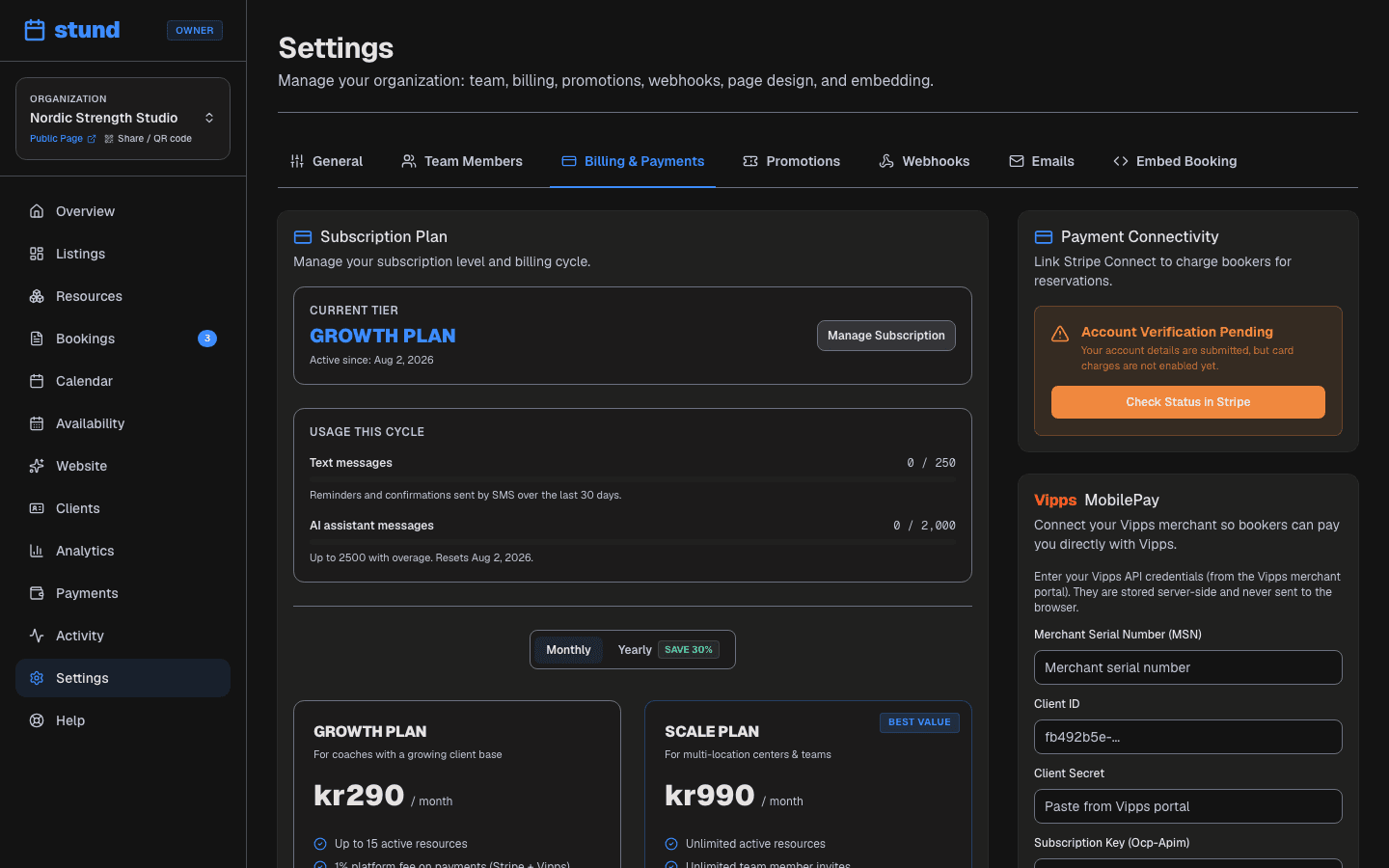
Which methods you can actually turn on depends on your Mollie account and country, so don't be surprised if one isn't available to you yet — Settings → Payments always shows which methods are ready to use.
Connecting VippsComing soon directly
First, get a VippsComing soon MobilePay business agreement at vippsmobilepay.com. You sign up with BankID and your organization number; most sole proprietors are approved the same day.
- In the VippsComing soon portal, open Utvikler (Developer) and choose the Produksjon (Production) keys
- In Stund, go to Settings → Payments → VippsComing soon MobilePay
- Paste the merchant serial number, client ID, client secret and subscription key
- Turn VippsComing soon on for any paid service
We check the keys against VippsComing soon before saving them, and store them encrypted. You can replace them later, but you can never read them back out of Stund — copy them from the VippsComing soon portal again if you need them.
VippsComing soon settles in NOK, DKK and EUR. If your organization currency is something else, clients won't be able to pay with VippsComing soon until you change it under Settings → Company.
What Stund's fee costs, and when it is taken
Stund's platform fee is a flat 0.5% of the payment, whichever provider you use and whatever method the client paid with. When it is taken depends on the provider:
- Through Mollie — deducted automatically the moment the charge happens. The rest lands in your own Mollie account within 1–2 business days. There's no separate transfer step and nothing added to a later invoice.
- Through your own VippsComing soon — VippsComing soon pays you in full, directly, so there is nothing for Stund to deduct at that moment. The fee is added up instead and charged once a month to the same card your Stund subscription runs on. Settings → Payments → VippsComing soon MobilePay always shows what has built up and the date it will be taken.
Either way it is the same 0.5%, and nothing about it changes what the client pays.
What clients see at checkout
When a client books an Online session, they're taken to a secure checkout page where they pay with whichever methods you've turned on — card, VippsComing soon or Klarna. Once payment succeeds, the booking confirms and they receive a confirmation email.
If payment fails, the booking stays pending and the slot remains reserved for ~45 minutes while they can retry. After that, the booking expires and releases the slot so others can book it.
A payment is authorized at checkout and captured in full when the booking is settled, a moment or two later — the money is only taken once the booking is confirmed to still stand. This works the same way on both providers. This matters in one case: if the slot has already been released by then — it expired, or you cancelled it — the authorization is simply released and the client is never charged at all, rather than being charged and refunded. Their bank releases the held amount within a few days. The booking's history calls this Authorization released, and there is nothing for you to do about it.
Cancellations and refunds
When you cancel a booking (or a client requests a refund within the cancellation window), the payment is reversed to the client's original payment method. The platform fee is never returned with it, on either provider — a fee already deducted at Mollie can't be reversed once the payment settles, and a fee accrued on a direct VippsComing soon payment stays owed for the same reason. The rule is deliberately the same both ways, so which provider you connected never changes what a refunded booking costs you.
If a client cancels too close to their session, your cancellation policy applies and they may not receive a full refund. See the coach editor for cancellation-window and refund-percentage settings.
Good to know
The platform fee is never returned on a refund, however it happens — a cancellation, a manual refund, or one you make in your provider's own dashboard. Only the client's own payment is reversed.
Refunding without cancelling
Sometimes you want to return money while the booking stands — a goodwill gesture, a session that ran short, or a price you agreed to adjust afterwards. Open the booking in Bookings and choose Refund.
- Pick Full refund, or Partial and enter a percentage.
- The dialog shows exactly what will be returned before you confirm.
- Add a reason if you want one — it is recorded on the booking's history.
The booking stays on your calendar either way. Use this too if a refund failed at your payment provider and you were emailed about it: the same button retries it.
Good to know
A refundable deposit is always returned in full, whatever percentage you choose. Deposits are the client's money held in escrow, not part of the session price.
Recording a payment you took in person — and undoing it
When a client pays you outside Stund — cash, a bank transfer, or your own card machine — open the booking and choose Mark as paid. The booking counts as settled and shows in your revenue, but no money moves through Stund and no platform fee applies. Use this only for money you have actually collected.
If you recorded that by mistake, or the arrangement fell through before the client paid, open the booking and choose Set as unpaid. It clears the recorded payment and puts the booking back to awaiting payment, ready to be marked paid again — or paid online — once things are sorted.
Good to know
Set as unpaid only shows on a booking you settled by hand: there is no money to send back. A booking paid online shows Refund instead, because that moves real money at the provider. So: Refund for online payments, Set as unpaid for an offline one you recorded in error.
Refunds and chargebacks handled at your provider
If you refund a payment straight from your Mollie dashboard instead of using the Refund button here, that's fine — we pick it up automatically. The booking is marked refunded and the amount shows in Payments just as it would for an in-app refund, so your totals stay correct either way. The platform fee is kept, exactly as it is for a refund made here.
For a prepaid package refunded this way, we record the money but keep the package active — the client keeps any unused credits and can still book with them. To take the credits back too, cancel the package with its Refund button here; it revokes the remaining credits and won't charge a second refund for money you already returned.
If a client disputes a card payment (a chargeback), Mollie pulls the disputed amount back right away and the booking is marked refunded immediately on your side — there is no pending phase where the money waits on the outcome. Chargeback liability sits with you, not with Stund: contest it with evidence in your own Mollie dashboard, which is the only place to do that. If the bank later rules in your favor, the payment stands again and the booking's history shows the reversal; either way, the platform fee is not returned.
Direct VippsComing soon payments have no chargeback process of this kind — a VippsComing soon dispute is settled between you and VippsComing soon directly, in your own VippsComing soon portal.
Returning a deposit, or keeping part of it
Where a booking took a refundable deposit, the booking's Return Deposit button releases it. If something was damaged or lost, enter an amount to keep and the rest goes back to the client. The dialog shows the amount they will receive, and both the amount kept and your reason are recorded on the booking's history so you can point to it later.
Unpaid bookings
Bookings set to Online require payment before they confirm. If a client starts checkout but leaves without paying:
- The slot stays reserved for ~45 minutes to give them time to retry
- If they don't pay within that window, the booking expires and releases the slot
- No money is ever taken; no notification is sent to you
This prevents abandoned checkouts from blocking your calendar.
Payment history
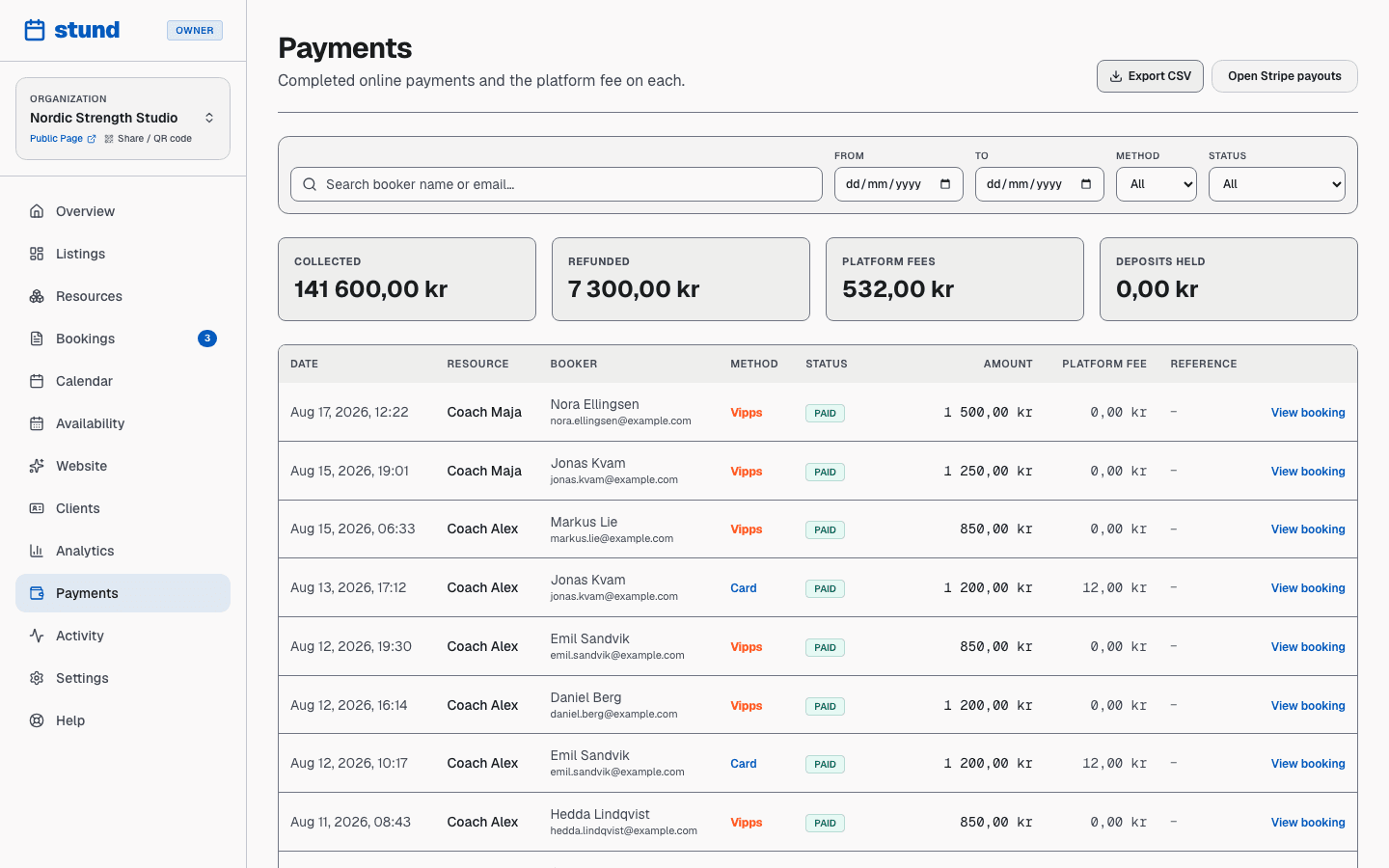
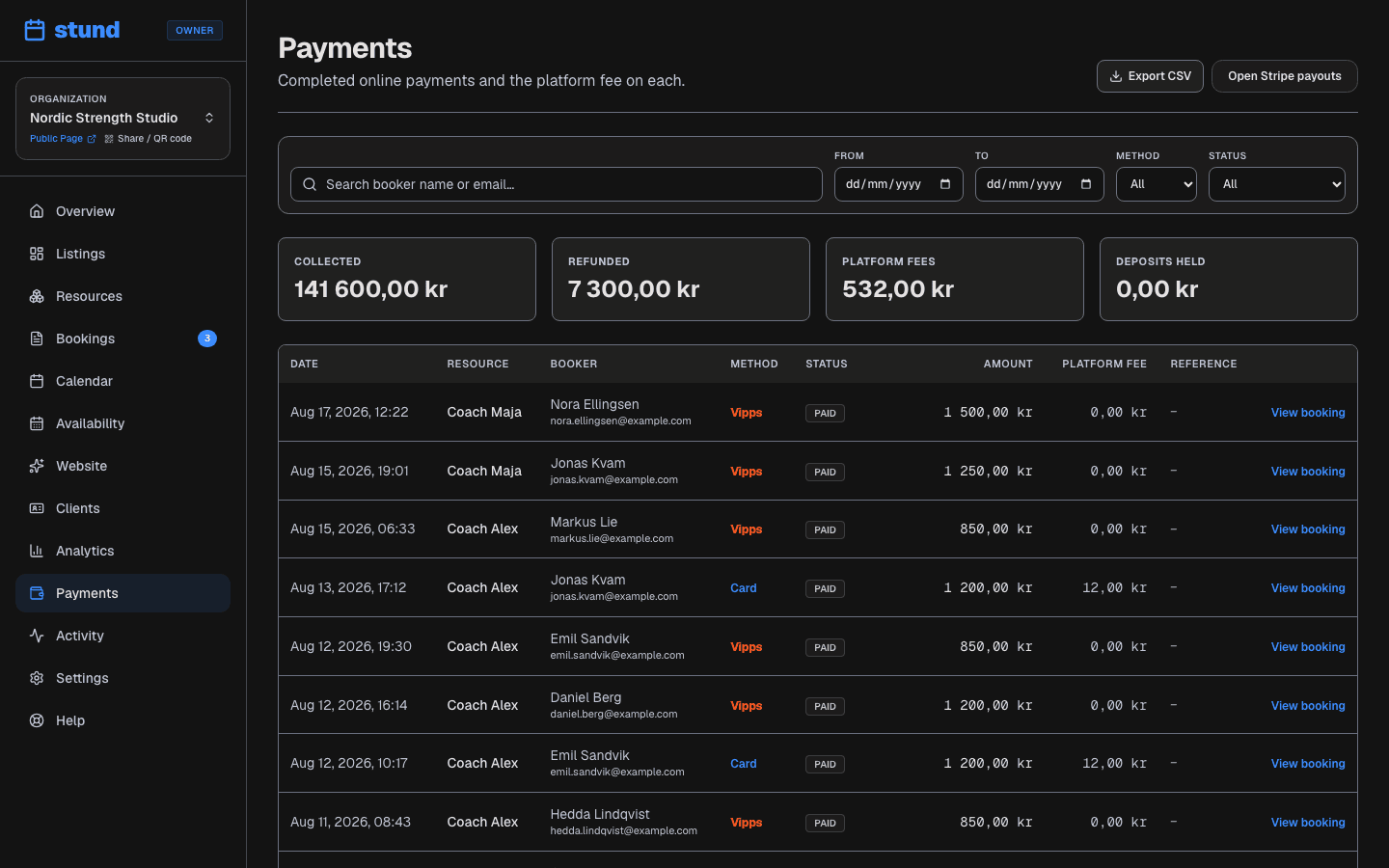
View all transactions (paid bookings, refunds, failed attempts) in Payments. You'll see:
- Booking details and the client's name
- Payment status (paid, refunded, failed, pending)
- Amount paid after platform fees
- Payment method (card, VippsComing soon, Klarna, or manually recorded)
- Settlement date
Finding one payment, or one month
The filter bar above the table narrows what you see:
- Search matches the client's name or email address.
- From and To bound the settlement date, in your organization's timezone. Both ends are included, so "to 31 March" covers all of the 31st.
- Method picks out card, VippsComing soon, Klarna or manually recorded payments.
- Status separates fully paid, partially refunded and fully refunded payments. "Partially refunded" means money has gone back but not all of it.
The four figures at the top follow your filters. With nothing filtered they cover every payment you have ever taken; set a date range and they cover that range instead — which is what you want when you are reconciling a month. A line under the cards reminds you when a filter is narrowing them.
Filters live in the page address, so you can bookmark "March, card payments only" or send the link to your accountant. Clear filters puts everything back.
View booking at the end of each row opens that exact booking, which is where refunds and deposit returns are handled.
Use Older payments at the bottom to walk back through the history a page at a time; your filters are carried along.
Good to know
Export CSV always downloads the full history, not the filtered view.
Export CSV downloads the whole payment history: one row per settled payment with the amount, any refund, the platform fee and the provider's reference. That reference is what your accountant, or your provider's support, will ask for.
For detailed payout history, disputes and transfers, sign in to your provider's own dashboard: my.mollie.com if you connected Mollie, or the VippsComing soon MobilePay portal if you connected VippsComing soon directly.